

Table of contents
- What stamped concrete paving is
- How the stamping process works
- Design options – colours, patterns, borders
- Performance benefits that matter in the UK
- Sub-base, joints, and drainage
- Slip resistance and surface protection
- Maintenance and life cycle
- Common mistakes to avoid
- Where stamped concrete is the right choice
- Planning, standards, and useful references
- Final thoughts and how InnoDez UK can help
What stamped concrete paving is
Stamped concrete, often called pattern imprinted concrete in the UK, is a monolithic slab poured in place and textured while plastic to resemble stone, brick, slate, or timber boards. Because it is a single concrete surface rather than individual units, joints and weeds are reduced and the finish looks continuous. For front drives, patios, retail forecourts, and footways, stamped concrete provides a tidy, decorative surface without the trip edges common to loose blocks when they settle.
How the stamping process works
A ready-mixed concrete with the right slump and aggregate is placed over a compacted sub-base. Colour is introduced with an integral pigment or a dry-shake hardener. Release agent is dusted on so the textured mats do not stick. While the slab still carries, installers place mats in sequence, working out from straight lines or curved borders to press the texture and grout lines. After curing, the surface is cleaned, any antiquing is adjusted, control joints are cut, and a sealer is applied. The result is a realistic texture with the strength and integrity of a continuous slab.
If you are comparing hard landscaping with wider building works, see how paving ties into MEP and structural coordination on the InnoDez UK Services page at https://innodez.co.uk/services/ and explore related design pieces on the InnoDez UK Blog at https://innodez.co.uk/blog/.
Design options – colours, patterns, borders
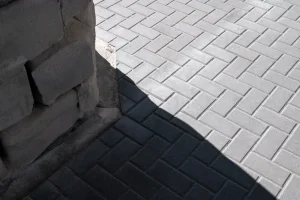
The palette is broad. Cobble and setts suit period streets, running-bond brick works well for townhouses, and large-format slate patterns give modern terraces a calm rhythm. Borders and bands elevate the look: a dark header course can frame a driveway and hide tyre scuffing, while curved soldier courses soften tight plots. Because the finish is cast in place, curves are simple and level changes can be handled with crisp steps and bullnosed edges. Use colour layering lightly so the surface remains believable rather than theatrical.
Performance benefits that matter in the UK
- Continuous surface reduces joint cleaning and suppresses weeds compared with many small-unit systems. Properly sealed, it resists de-icing salts used in colder regions and stands up to rain and road grime. Texture breaks up glare and improves traction underfoot.
- Monolithic slabs spread loads well and are less prone to rutting under wheels. Tight radii and narrow bands are easier to cast than to lay with individual units, which is helpful on small urban plots.
Sub-base, joints, and drainage
Stamped concrete looks best when the groundwork is right. Use a well-compacted granular sub-base, typically MOT Type 1, graded and compacted in layers. Create falls to gullies or linear channels so water never sits. Remember that a continuous slab still needs controlled cracking. Set a joint plan that suits the pattern so cuts land on fake grout lines where possible. Joints should be clean, straight, and sealed so water cannot dwell. Where drives meet public footways, check kerb and crossing levels to maintain upstands and avoid ponding.
Slip resistance and surface protection
Any decorative finish must remain safe in the wet. Choose textures with genuine relief and avoid heavy seals that leave a glassy skin. Modern acrylic or polyurethane sealers can be formulated for a satin finish and combined with fine anti-slip additives. Re-sealing at sensible intervals is part of the life cycle, but more is not better. Apply thin, even coats and allow full cure between applications. On shaded sites with algae risk, include a gentle biocidal wash in the maintenance plan.
Maintenance and life cycle
All paving needs care. Stamped concrete is straightforward if habits are set early. Keep grit off the surface with seasonal sweeping. Wash with low-pressure water and a neutral cleaner, not strong acids. Inspect joints, downpipes, and channel drains each autumn so water does not undermine edges. When tyre marks appear, a mild solvent wipe before re-seal usually restores the surface. Expect to refresh sealer periodically based on exposure and traffic so colour reads cleanly and water beads as intended.
Common mistakes to avoid
- Pouring without a joint plan. Cracks will choose their own path if you do not provide one, and it will rarely align with the pattern. Plan cuts around corners, step landings, and service penetrations before concrete lorries arrive.
- Over-sealing. Thick, glossy coats can become slippery and may blush or trap moisture. Thin films with anti-slip additive and patient cure times give better, safer results.
Where stamped concrete is the right choice
Choose stamped concrete when you need a decorative look with minimal joints, tidy curves, and a robust surface that resists migration and wobble. Drives with tight plan shapes, terrace steps, and retail forecourts benefit from the continuous finish. If later service access is likely, plan discreet removable panels where utility ducts run so future works do not scar the main field. Sites with significant tree roots or frequent utility interventions may be better suited to modular paving that can be lifted and relaid in sections.
Planning, standards, and useful references
Front garden conversions to parking sometimes require planning permission depending on local authority rules, impermeable area, and discharge to highway drains. Where in doubt, check local guidance before breaking ground. Concrete specification should align with UK practice on durability and freeze-thaw exposure. The Concrete Centre provides helpful guidance on mix selection, reinforcement, and curing suitable for British weather. Installers can also reference independent technical notes on sub-bases, falls, and edge restraints.
External references
The Concrete Centre – exterior concrete guidance: https://www.concretecentre.com/
Pavingexpert – installation and sub-base know-how: https://www.pavingexpert.com/
Final thoughts and how InnoDez UK can help
Stamped concrete paving blends design freedom with a solid, low-joint surface that stands up to British weather when detailed correctly. The best outcomes come from sound sub-bases, sensible joint planning, realistic textures, and sealers applied with discipline. If you are weighing stamped concrete against block paving or natural stone, we can model layouts, falls, joints, and details so the finish looks right and performs well over time.
See recent hard landscaping work within broader schemes on the InnoDez UK Projects page at https://innodez.co.uk/projects/ and speak with our team through the InnoDez UK Contact page at https://innodez.co.uk/contact/.