
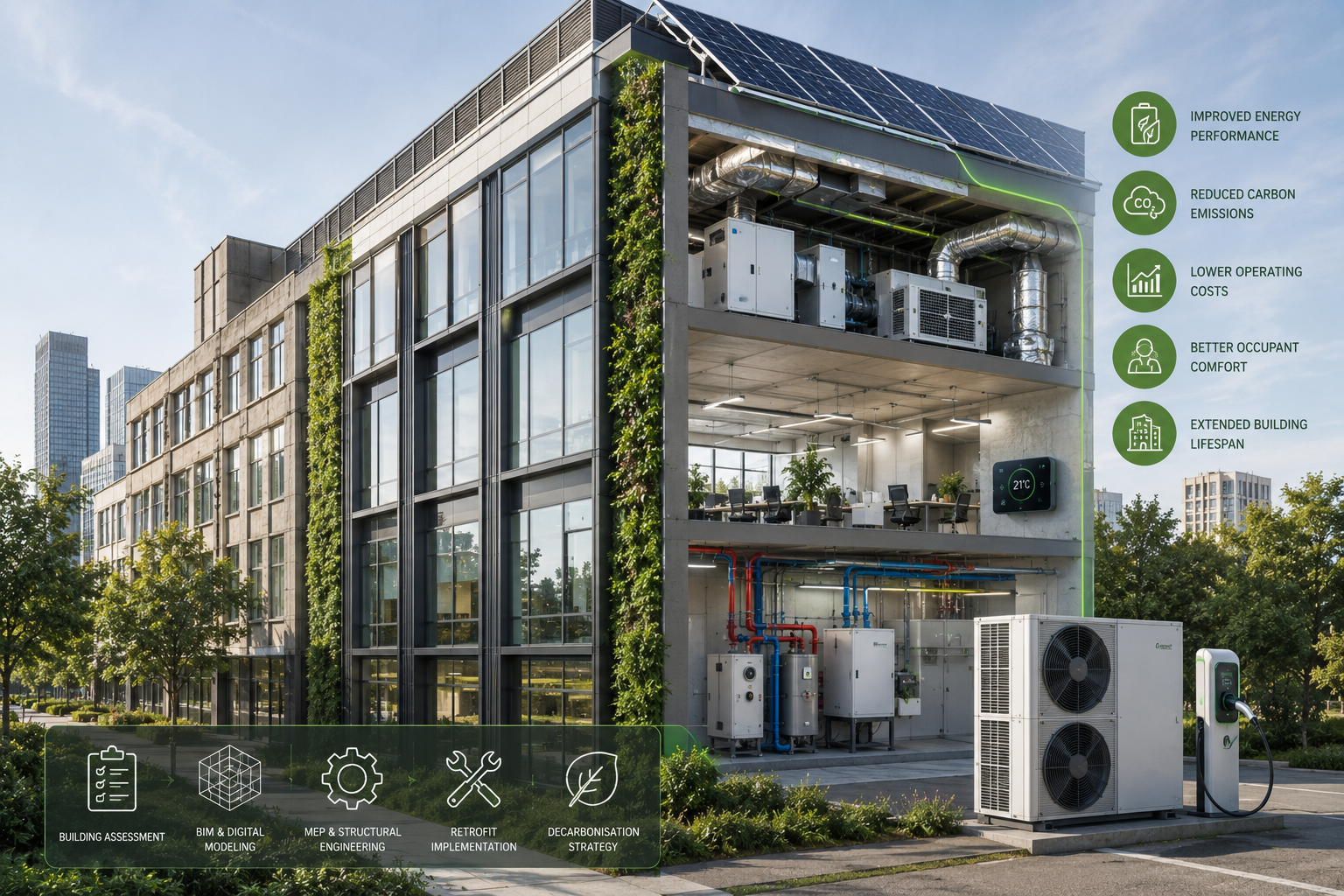
Why Retrofit and Decarbonisation Matter
Across the UK, many commercial buildings were constructed decades ago, long before modern energy efficiency standards, sustainability targets, and advanced building technologies became the norm. While these buildings continue to serve businesses, they often consume more energy, produce higher carbon emissions, and cost significantly more to operate than newer developments.
Rather than demolishing and rebuilding, many property owners and developers are choosing to retrofit existing buildings. Retrofitting allows commercial properties to improve energy performance, reduce operational costs, and extend the lifespan of their assets while supporting the UK’s ambitious Net Zero goals.
At InnoDez, we provide integrated Mechanical, Electrical, Plumbing (MEP), Structural Engineering, and BIM services that help clients successfully modernise commercial buildings through carefully planned retrofit and decarbonisation strategies.
What Is Commercial Building Retrofit?
A retrofit involves upgrading existing building systems, infrastructure, or structural components to improve performance without constructing an entirely new building.
Typical retrofit projects include:
- Office refurbishments
- Hotel renovations
- Healthcare facility upgrades
- Retail refurbishments
- Educational buildings
- Industrial facilities
- Mixed-use developments
- Public sector buildings
Retrofitting focuses on improving efficiency, comfort, safety, and sustainability while minimising disruption to building occupants.
Understanding Building Decarbonisation
Building decarbonisation is the process of reducing or eliminating carbon emissions generated during a building’s operation.
For commercial properties, this often involves replacing older, carbon-intensive systems with modern, energy-efficient alternatives.
Common decarbonisation measures include:
- Electrifying heating systems
- Installing heat pumps
- Upgrading HVAC equipment
- Improving insulation and building fabric
- Replacing outdated lighting with LED systems
- Integrating renewable energy technologies
- Enhancing building automation systems
- Reducing water consumption
Together, these improvements help lower both energy use and greenhouse gas emissions.
Why Retrofit Existing Buildings?
Retrofitting offers numerous advantages over demolition and new construction.
Lower Carbon Footprint
Demolishing a building and constructing a new one requires significant materials, transportation, and energy, all of which contribute to embodied carbon emissions.
Retrofitting preserves much of the existing structure, reducing waste and making better use of existing resources.
Reduced Operating Costs
Older buildings often suffer from inefficient mechanical systems, outdated lighting, poor insulation, and ageing electrical infrastructure.
Modern upgrades can significantly reduce:
- Electricity consumption
- Heating costs
- Cooling costs
- Maintenance expenses
- Water usage
These savings can improve long-term return on investment.
Improved Occupant Comfort
Building users increasingly expect comfortable, healthy working environments.
Retrofits can improve:
- Indoor air quality
- Thermal comfort
- Ventilation
- Lighting quality
- Noise control
Better indoor environments contribute to higher productivity and improved tenant satisfaction.
Increased Property Value
Energy-efficient buildings are becoming more attractive to investors, occupiers, and commercial tenants.
Modernised buildings often benefit from:
- Higher occupancy rates
- Lower vacancy periods
- Increased rental values
- Improved market competitiveness
Retrofitting can therefore enhance both operational performance and long-term asset value.
Key Engineering Systems in Commercial Retrofits
Successful retrofit projects require careful coordination across multiple engineering disciplines.
Mechanical Engineering
Mechanical upgrades typically include:
- High-efficiency HVAC systems
- Air handling unit replacement
- Heat recovery ventilation
- Variable refrigerant flow (VRF) systems
- Heat pump installations
- Energy recovery systems
- Improved ventilation controls
These systems help reduce energy consumption while maintaining occupant comfort.
Electrical Engineering
Electrical improvements often involve:
- LED lighting upgrades
- Intelligent lighting controls
- Power distribution modernisation
- Electrical panel upgrades
- Building Management Systems (BMS)
- Renewable energy integration
- Electric vehicle charging infrastructure
Modern electrical systems improve reliability while supporting future technologies.
Plumbing Engineering
Plumbing retrofits focus on reducing water consumption and improving system performance.
Typical upgrades include:
- Water-efficient fixtures
- Low-flow fittings
- Greywater recycling systems
- Rainwater harvesting
- Domestic hot water improvements
- Leak detection systems
Efficient plumbing systems contribute to lower operating costs and sustainability goals.
Structural Engineering
Some retrofit projects require structural modifications to accommodate new building systems or altered layouts.
Structural engineers may assist with:
- Equipment support structures
- Roof strengthening for solar panels
- Plant room modifications
- Floor reinforcement
- Building extensions
- Seismic upgrades where applicable
Early structural assessment helps minimise construction risks.
The Importance of Building Information Modeling (BIM)
Existing buildings often contain undocumented services, making retrofit projects more complex than new construction.
Building Information Modeling (BIM) enables project teams to:
- Capture existing conditions using laser scanning
- Create accurate digital building models
- Coordinate new MEP installations
- Detect clashes before construction
- Improve installation sequencing
- Reduce costly on-site changes
BIM improves collaboration and helps deliver retrofit projects more efficiently.
Common Challenges in Retrofit Projects
Every existing building presents unique challenges.
Common issues include:
- Limited ceiling space
- Unknown building conditions
- Outdated infrastructure
- Restricted plant room capacity
- Asbestos management
- Maintaining operations during construction
- Compliance with modern building regulations
Early engineering investigations help identify these challenges before construction begins.
Compliance with UK Building Regulations
Retrofit projects must comply with current UK regulations, even when working within existing structures.
Engineering teams consider:
- Building Regulations Part L (Conservation of Fuel and Power)
- Part F (Ventilation)
- Part G (Sanitation, Hot Water Safety and Water Efficiency)
- Part B (Fire Safety)
- Part M (Access to Buildings)
- Energy Performance Certificate (EPC) requirements
- Minimum Energy Efficiency Standards (MEES)
Meeting these standards helps future-proof buildings and improve environmental performance.
Technologies Driving Building Decarbonisation
Modern retrofit projects increasingly incorporate innovative technologies such as:
- Air source heat pumps
- Ground source heat pumps
- Solar photovoltaic (PV) systems
- Battery energy storage
- Smart Building Management Systems
- Occupancy sensors
- IoT-enabled monitoring
- Demand-controlled ventilation
- Smart energy metering
These technologies improve operational efficiency while supporting long-term sustainability objectives.
Which Buildings Benefit Most from Retrofit?
Commercial retrofit solutions are suitable for a wide range of properties, including:
- Office buildings
- Retail centres
- Hotels
- Healthcare facilities
- Schools and universities
- Warehouses
- Manufacturing facilities
- Government buildings
- Mixed-use developments
Whether a building requires a full refurbishment or targeted system upgrades, engineering-led retrofits can significantly improve performance.
Why Choose InnoDez?
At InnoDez, we provide integrated engineering solutions that help clients modernise commercial buildings with confidence. Our multidisciplinary team delivers coordinated MEP engineering, structural engineering, and BIM services that reduce project risks, improve energy performance, and support long-term operational success.
From initial assessments and design through construction coordination and implementation, we work closely with developers, architects, contractors, and building owners to deliver practical, cost-effective retrofit solutions tailored to each project.
Conclusion
Retrofitting and decarbonising commercial buildings is one of the most effective ways to improve energy efficiency, reduce carbon emissions, and extend the life of valuable property assets. As sustainability expectations and regulatory requirements continue to evolve across the UK, investing in modern engineering solutions has become essential for maintaining competitive, high-performing buildings.
With expert MEP engineering, structural design, and BIM coordination, InnoDez helps clients transform ageing buildings into efficient, future-ready environments that meet today’s performance standards while preparing for tomorrow’s challenges.