
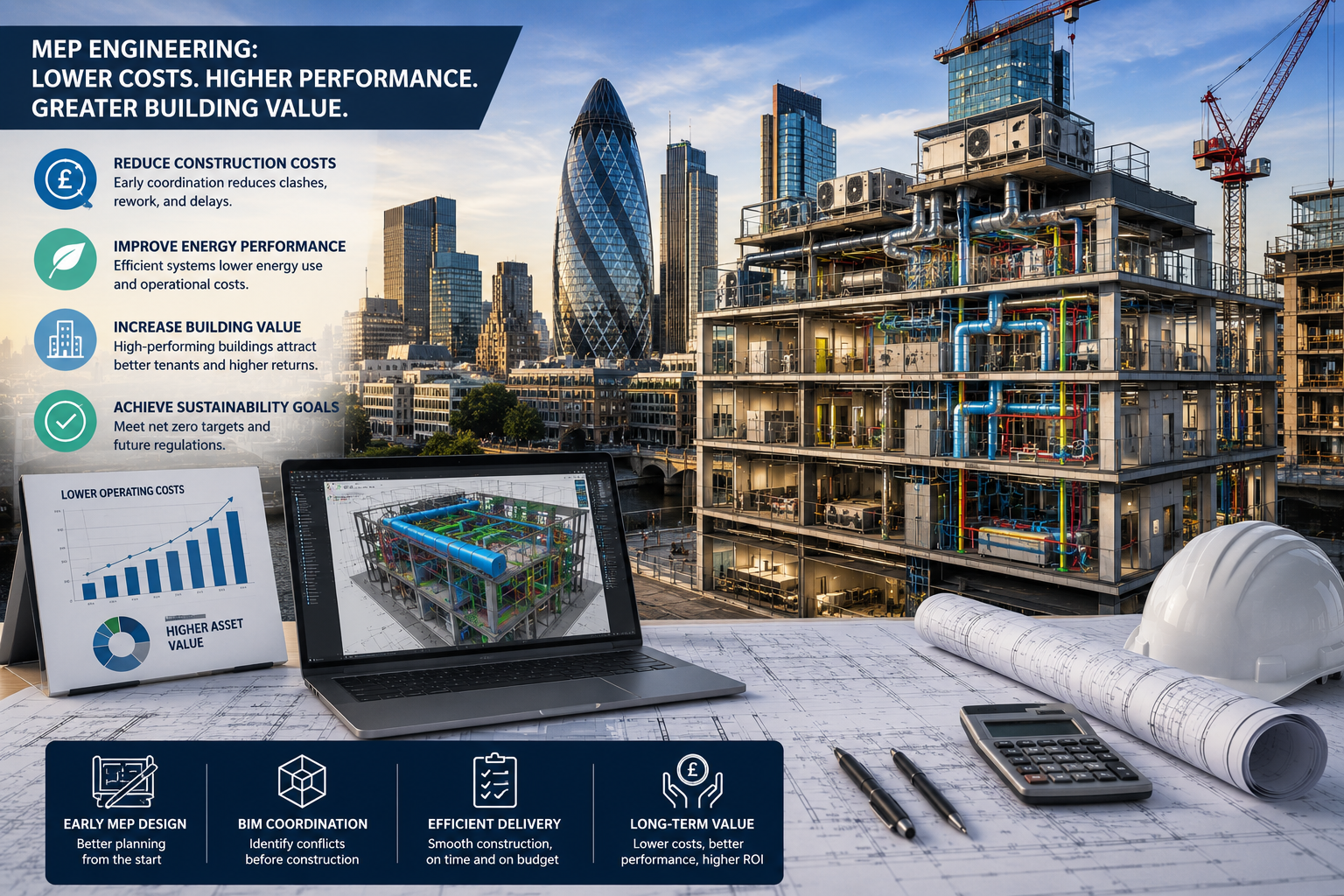
Why MEP Engineering Has Become a Strategic Investment for London Developers
When discussing construction budgets, most attention is typically focused on architecture, structural systems, and finishes. However, for modern developments in London, mechanical, electrical, and public health systems often represent 30% to 50% of total construction costs.
More importantly, these systems determine how efficiently a building operates for decades after construction is complete.
For developers, investors, architects, and building owners, MEP engineering is no longer simply a technical requirement. It has become a strategic tool for reducing costs, improving energy performance, accelerating approvals, and increasing long-term asset value.
As London’s construction market continues to evolve under stricter sustainability requirements and rising operational costs, the quality of MEP engineering can significantly influence a project’s financial success.
The Hidden Cost of Poor MEP Planning
Many project delays and budget overruns originate from building services conflicts that were not identified during design.
Common issues include:
- HVAC systems conflicting with structural elements
- Electrical routes competing for ceiling space
- Drainage systems requiring redesign during construction
- Equipment rooms lacking sufficient access space
- Late-stage compliance issues
These problems often lead to:
- Design revisions
- Construction delays
- Increased labour costs
- Material waste
- Change orders
In London’s high-cost construction environment, even minor coordination issues can have substantial financial consequences.
Early MEP coordination reduces these risks by identifying conflicts before construction begins.
Why London Developments Face Unique Engineering Challenges
Unlike many UK regions, London projects frequently encounter additional complexities:
Limited Construction Space
Many developments are built within constrained urban environments where plant rooms, risers, and service routes must be carefully planned.
Refurbishment and Adaptive Reuse
A significant percentage of London’s construction activity involves upgrading existing buildings rather than new construction.
Older buildings often present challenges such as:
- Limited ceiling voids
- Outdated infrastructure
- Restricted service routes
- Heritage considerations
Increasing Sustainability Requirements
Developers are under growing pressure to reduce energy consumption and carbon emissions while maintaining occupant comfort.
This places greater emphasis on efficient HVAC systems, smart controls, and sustainable building services.
The Relationship Between MEP Design and Building Value
Investors increasingly evaluate buildings based on operational performance rather than construction cost alone.
Well-designed MEP systems contribute directly to:
Lower Operating Costs
Energy-efficient HVAC, lighting, and water systems reduce monthly utility expenses.
Improved Tenant Satisfaction
Comfortable indoor environments improve tenant retention and occupancy rates.
Higher Asset Value
Buildings with lower operational costs and stronger sustainability credentials often command higher market values.
Reduced Maintenance Costs
Properly engineered systems typically experience fewer failures and lower maintenance requirements.
For commercial property owners, these benefits can significantly influence long-term return on investment.
Net Zero Targets Are Reshaping MEP Engineering
The UK’s commitment to reducing carbon emissions has transformed how building services are designed.
Mechanical and electrical systems now play a critical role in achieving:
- Net Zero Carbon objectives
- BREEAM certification targets
- ESG requirements
- Corporate sustainability goals
Modern MEP strategies often include:
- Heat pump technology
- Energy recovery systems
- Smart building controls
- Renewable energy integration
- Demand-controlled ventilation
These solutions help future-proof developments against evolving regulations and market expectations.
Why BIM Is Essential for Modern London Projects
Building Information Modelling (BIM) has become one of the most valuable tools in MEP engineering.
Rather than discovering issues during construction, BIM allows project teams to identify conflicts digitally during design.
This results in:
- Better coordination
- Reduced construction risk
- Improved communication
- Faster project delivery
- Greater cost certainty
For complex London developments, BIM has become a critical component of successful project execution.
Engineering Decisions That Affect Occupant Experience
Occupants rarely notice excellent engineering, but they immediately notice poor engineering.
Building services directly affect:
- Indoor air quality
- Thermal comfort
- Lighting quality
- Acoustic performance
- Water pressure and reliability
These factors influence productivity, wellbeing, customer satisfaction, and tenant retention.
As hybrid working, wellness-focused design, and ESG initiatives continue to grow, occupant experience is becoming an increasingly important consideration during MEP design.
Future Trends Shaping MEP Engineering in London
Several trends are transforming building services design:
Electrification of Buildings
Developers are moving away from traditional gas systems toward fully electric solutions.
Smart Buildings
Connected systems allow operators to monitor performance and optimise energy consumption in real time.
AI and Predictive Maintenance
Building systems are becoming increasingly intelligent, helping identify potential failures before they occur.
Increased Focus on Carbon Reduction
Future regulations are expected to place even greater emphasis on operational and embodied carbon.
These trends are making MEP engineering one of the most influential disciplines in modern building design.
Partner With an Experienced London MEP Engineering Consultancy
Successful developments require more than compliance. They require building services that improve efficiency, reduce costs, support sustainability, and enhance long-term asset performance.
At InnoDez UK, we help developers, architects, contractors, and property owners create high-performing buildings through coordinated and forward-thinking MEP engineering solutions.
Whether you’re planning a commercial development, residential scheme, refurbishment project, or mixed-use building, our team provides the expertise needed to support successful project outcomes across London and the UK.