
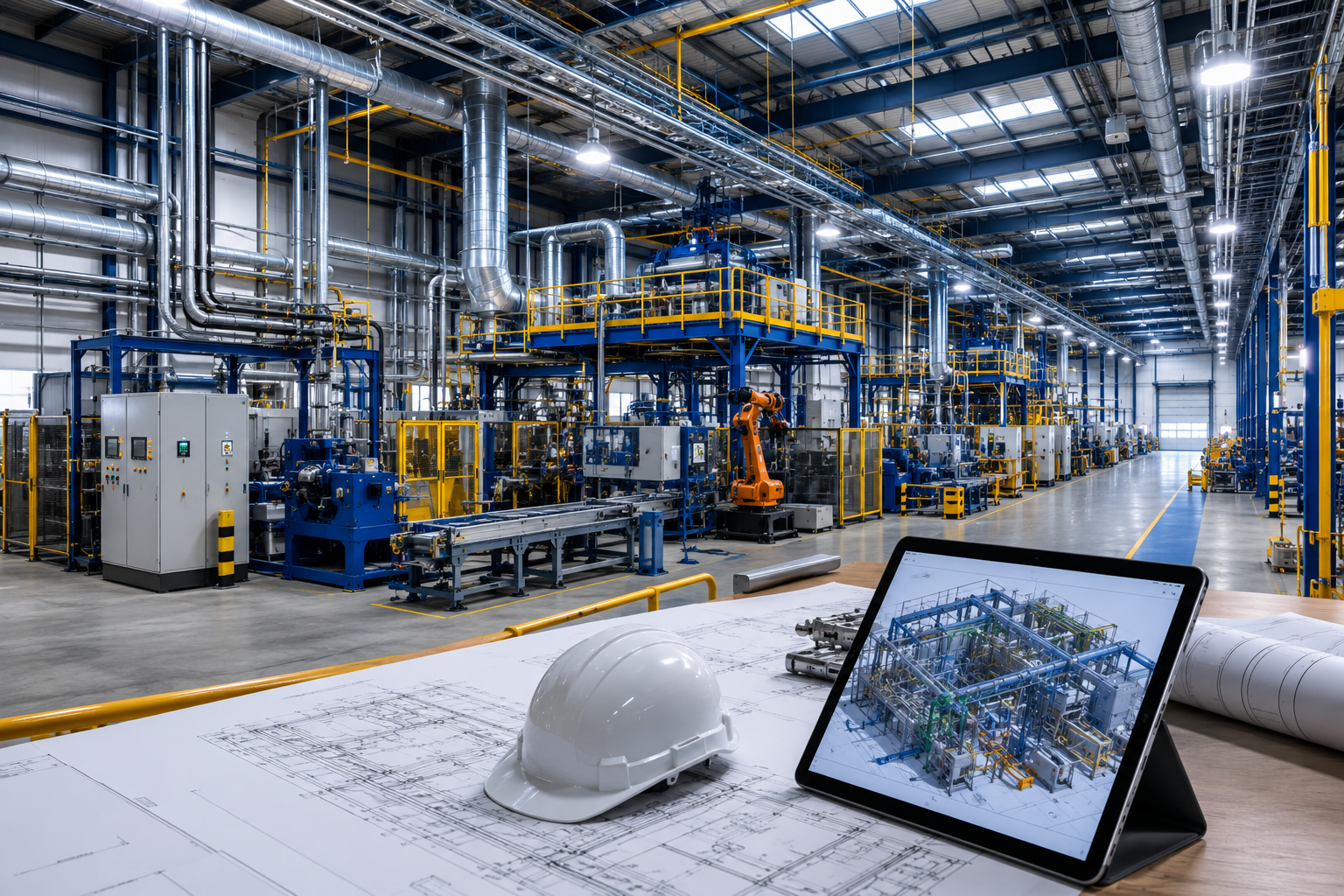
Why Industrial Facilities Require Specialised Engineering Design
Industrial and manufacturing facilities are among the most demanding building types to design and construct. Unlike traditional commercial buildings, manufacturing environments rely heavily on complex mechanical, electrical, and public health (MEP) systems to support production processes, maintain operational efficiency, and ensure workplace safety.
From food processing plants and pharmaceutical facilities to logistics warehouses and heavy manufacturing plants, every industrial project presents unique operational requirements that directly influence building design.
The increasing adoption of automation, digital technologies, and sustainability initiatives has further increased the complexity of industrial developments. Modern facilities must not only support current production demands but also remain adaptable to future expansion and technological advancements.
At InnoDez, we provide coordinated MEP engineering and BIM services that help industrial clients develop efficient, resilient, and future-ready facilities that support long-term business growth.
Understanding the Complexity of Industrial Facilities
Industrial buildings are designed around operational processes rather than simply accommodating occupants.
Every engineering decision must consider factors such as:
- Production workflows
- Equipment requirements
- Energy demands
- Process cooling needs
- Environmental controls
- Worker safety
- Regulatory compliance
- Future scalability
Unlike standard office developments, industrial facilities often contain specialised equipment that places significant demands on building services infrastructure.
As a result, early engineering involvement is essential to ensure the building can support operational requirements efficiently and reliably.
The Role of MEP Engineering in Manufacturing Facilities
Mechanical, electrical, and public health engineering systems form the backbone of industrial operations.
Well-designed MEP systems improve:
- Productivity
- Energy efficiency
- Equipment reliability
- Operational resilience
- Employee comfort
- Environmental performance
Poorly designed infrastructure can lead to production interruptions, increased maintenance costs, and reduced operational efficiency.
Mechanical Engineering for Industrial Operations
Mechanical systems in industrial facilities extend far beyond conventional heating and cooling systems.
Industrial mechanical infrastructure may include:
- Process ventilation systems
- Dust extraction systems
- Compressed air systems
- Process cooling systems
- Environmental control systems
- Heat recovery technologies
- Industrial refrigeration systems
These systems are often critical to maintaining production quality and ensuring equipment operates within required environmental conditions.
Process Cooling Systems
Many manufacturing processes generate substantial amounts of heat.
Without adequate cooling, equipment performance and product quality can suffer significantly.
Common cooling solutions include:
- Chilled water systems
- Cooling towers
- Process cooling loops
- Refrigeration systems
- Heat exchangers
- Precision environmental controls
Engineering teams must carefully assess process requirements to develop efficient and reliable cooling strategies.
Industrial Ventilation and Air Quality Management
Industrial ventilation systems are essential for maintaining safe and productive working environments.
Manufacturing activities can generate:
- Dust
- Fumes
- Heat
- Chemical vapours
- Airborne contaminants
Proper ventilation systems help:
- Protect worker health
- Improve indoor air quality
- Maintain regulatory compliance
- Reduce equipment contamination
- Improve production efficiency
Depending on the industry, facilities may require specialised extraction systems, filtration technologies, or cleanroom environments.
Electrical Infrastructure for Manufacturing Facilities
Industrial facilities typically have significant power requirements.
Electrical systems must support both building operations and production equipment while maintaining reliability and flexibility.
Power Distribution Systems
Industrial electrical systems may include:
- High-capacity distribution networks
- Dedicated process power systems
- Backup generators
- Uninterruptible power supplies (UPS)
- Motor control centres
- Renewable energy integration
Power infrastructure must be designed to accommodate both current and future operational demands.
Supporting Automation and Smart Manufacturing
Industry 4.0 technologies are transforming manufacturing operations.
Modern facilities increasingly rely on:
- Robotics
- Automated production systems
- Smart sensors
- Internet of Things (IoT) devices
- Real-time monitoring systems
- Data analytics platforms
These technologies require robust electrical and communications infrastructure to ensure reliable performance.
Public Health Engineering for Industrial Facilities
Public health engineering plays an important role in supporting industrial operations.
Design considerations may include:
- Process water systems
- Wastewater management
- Water treatment solutions
- Chemical storage systems
- Sanitary facilities
- Drainage systems
Certain industries, such as pharmaceuticals and food manufacturing, require particularly stringent water quality and hygiene standards.
Public health systems must therefore be designed to support both operational requirements and regulatory compliance.
BIM and Digital Engineering in Industrial Projects
Industrial projects often involve highly complex building services and equipment installations.
Building Information Modelling (BIM) has become an essential tool for improving coordination and reducing project risks.
Benefits of BIM for Industrial Facilities
BIM enables project teams to:
- Coordinate complex building services
- Detect clashes before construction
- Improve equipment layout planning
- Optimise maintenance access
- Reduce installation conflicts
- Improve project visualisation
By improving collaboration between disciplines, BIM helps reduce costly delays and supports more efficient project delivery.
Sustainability in Industrial Building Design
Sustainability is becoming increasingly important across the manufacturing sector.
Organisations are under growing pressure to reduce:
- Energy consumption
- Carbon emissions
- Water usage
- Waste generation
- Operational costs
Engineering strategies that support sustainability include:
- Energy-efficient HVAC systems
- Heat recovery technologies
- Smart building controls
- Renewable energy integration
- Water recycling systems
- High-efficiency lighting systems
Well-designed facilities can significantly reduce operating costs while supporting corporate sustainability objectives.
Designing for Future Expansion and Flexibility
Manufacturing operations continuously evolve in response to changing technologies, market demands, and business growth.
Industrial facilities should therefore be designed with future adaptability in mind.
Future-proofing strategies may include:
- Modular infrastructure design
- Flexible production spaces
- Expandable electrical systems
- Additional utility capacity
- Scalable building services
- Digital infrastructure readiness
A flexible facility can adapt more easily to future operational changes without requiring extensive modifications.
Safety and Regulatory Compliance
Industrial environments present unique health and safety challenges.
Engineering design must consider:
- Fire protection requirements
- Hazardous materials management
- Emergency power systems
- Ventilation standards
- Occupational health regulations
- Environmental regulations
Early coordination between engineers, operators, and regulatory authorities helps ensure facilities meet all necessary compliance requirements.
The Rise of Smart Industrial Facilities
Smart technologies are rapidly transforming manufacturing environments.
Connected buildings now utilise:
- Building Management Systems (BMS)
- Predictive maintenance technologies
- Digital twins
- Energy monitoring systems
- Automated controls
- Real-time operational analytics
These technologies provide facility managers with valuable insights that improve efficiency, reduce downtime, and support better decision-making.
How InnoDez Supports Industrial and Manufacturing Projects
At InnoDez, we provide multidisciplinary MEP engineering and BIM services that support industrial developments from concept design through construction and operation.
Our teams work closely with clients to develop practical engineering solutions that improve efficiency, support operational requirements, and accommodate future growth.
Through integrated design, digital coordination, and technical expertise, we help create manufacturing environments that are safe, efficient, and resilient.
Conclusion
Industrial and manufacturing facilities depend on carefully coordinated engineering systems to support productivity, safety, and long-term business success.
From process cooling and power distribution to smart manufacturing technologies and sustainability initiatives, every aspect of facility design plays a role in operational performance.
As the manufacturing sector continues to evolve, integrated MEP engineering and digital design solutions will remain essential for creating efficient, future-ready industrial environments that can adapt to changing technologies and market demands.